

WebExtrator Web Page Rendering API Integration Guide
POST https://api.worldai.chat/webextrator/render
The WebExtrator Web Page Rendering API is a web page rendering service based on headless Chromium. Given a URL, it returns fully rendered HTML (including JS-injected content), plain text, page title, and the final URL.
Render is the lowest-level interface of WebExtrator. If you need structured extraction results (article body,
product prices, recipe ingredients …), please use
/webextrator/extract —— it runs a complete typed extraction pipeline
on the same rendering foundation.
¶ Application Process
To use the WebExtrator service page, first go to the WorldAi Console to obtain your API Token and keep it for later use.
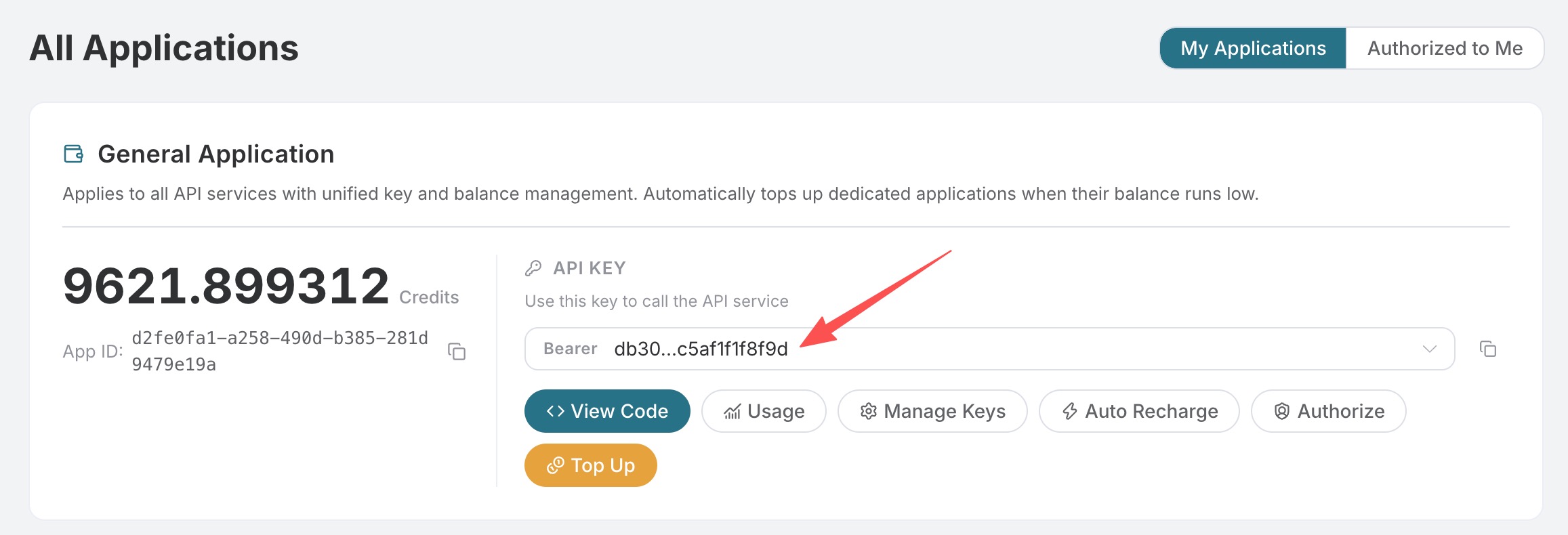
If you have not logged in or registered, you will be automatically redirected to the login page inviting you to register and log in. After completion, you will automatically return to the current page.
One API Token can invoke all services on the platform; there is no need to apply separately for each service. Your first application includes free credits for a free trial; when credits are insufficient, you can recharge your general balance in the Console.
📘 Full documentation: WebExtrator Service Page →
¶ Authentication
All WebExtrator interfaces use standard Bearer Token authentication:
Authorization: Bearer YOUR_API_KEY
Content-Type:  application/json
¶ Request Parameters
| Field | Type | Required | Default | Description |
|---|---|---|---|---|
url |
string | ✅ | — | The page URL to render; must be http(s)://. |
user_agent |
string | ❌ | Built-in UA pool rotation | Custom User-Agent. |
timeout |
integer | ❌ | 30 |
Single navigation timeout (positive integer seconds). |
wait_until |
enum | ❌ | load |
Load completion event: load / domcontentloaded / networkidle / commit. |
delay |
integer | ❌ | 0 |
Additional wait seconds after wait_until is triggered (non-negative integer) (for secondary SPA rendering). |
wait_for_selector |
string | ❌ | — | Wait for this CSS selector to appear, more reliable than networkidle. |
block_resources |
string[] | ❌ | ["image","font","media"] |
Resource types to block, options: image / font / media / stylesheet / xhr / fetch. |
headers |
object | ❌ | — | Additional HTTP request headers (for example, {"Accept-Language": "en-US"}). |
cookies |
array | ❌ | — | Cookies injected before navigation; see the structure below. |
callback_url |
string | ❌ | — | Callback address in asynchronous mode; the platform POSTs the complete result to this address when the task is completed. |
bypass_cache |
boolean | ❌ | false |
Skip Redis cache reads (but the result of this request will still be written back to the cache). |
cache_ttl_seconds |
integer | ❌ | 3600 |
Custom cache TTL for this write; passing 0 means do not cache this response. |
async |
boolean | ❌ | false |
Set to true to immediately return task_id; retrieve results through callback_url or the Tasks API. |
The platform contract uniformly uses snake_case. The internal rendering service supports camelCase, but external calls must always use snake_case.
¶ Cookie Structure
{
  "name":      "string",
  "value":     "string",
  "domain":    "string",
  "path":      "/",
  "expires":   1735689600,
  "httpOnly":  false,
  "secure":    true,
  "sameSite":  "Lax"
}
¶ Synchronous Response
{
  "success": true,
  "task_id": "550e8400-e29b-41d4-a716-446655440000",
  "trace_id": "550e8400-e29b-41d4-a716-446655440001",
  "started_at": 1777717800.123,
  "finished_at": 1777717801.234,
  "elapsed": 1.111,
  "data": {
    "kind": "render",
    "url": "https://example.com",
    "finalUrl": "https://example.com/",
    "title": "Example Domain",
    "status": 200,
    "html": "<!DOCTYPE html><html>...</html>",
    "text": "Example Domain\nThis domain is for use in illustrative examples...",
    "userAgent": "Mozilla/5.0 ...",
    "elapsedMs": 1108
  }
}
| Field | Type | Description |
|---|---|---|
data.kind |
string | Fixed as "render". |
data.url |
string | The URL you submitted. |
data.finalUrl |
string | The final URL after following redirects. |
data.title |
string | The rendered document.title. |
data.status |
number | null | The HTTP status code of the main navigation. |
data.html |
string | Complete rendered HTML. |
data.text |
string | document.body.innerText snapshot (use Extract for cleaner body content). |
data.userAgent |
string | The UA actually used. |
data.elapsedMs |
number | Browser rendering time only. |
data.cached |
boolean? | true when the cache is hit. |
data.cacheStoredAt |
number? | Unix timestamp in milliseconds when the cache entry was first written. |
¶ Asynchronous Response
When async=true (or callback_url is provided), it immediately returns (HTTP 200):
{
  "success": true,
  "task_id": "550e8400-...",
  "trace_id": "6ba7b810-...",
  "started_at": 1777717800.123
}
The result will be pushed via POST to callback_url (if configured), or actively queried through
/webextrator/tasks.
¶ Callback Structure
The platform POSTs an envelope identical to synchronous mode to callback_url,
with Content-Type: application/json. Returning any 2xx is considered acknowledged; 5xx will be
retried with exponential backoff for approximately 5 minutes.
¶ Error Responses
| HTTP | error.code |
Meaning |
|---|---|---|
| 400 | bad_request |
The request body did not pass Zod validation (missing url, incorrect type …). |
| 401 | unauthorized |
Missing or invalid Authorization: Bearer …. |
| 402 | (x402) | Insufficient platform balance, returns an x402 payment requirement envelope. |
| 408 | timeout |
Navigation exceeded timeout. |
| 429 | queue_busy |
The synchronous queue is congested, please retry or use async=true. |
| 500 | internal_error |
Unhandled server-side exception (browser crash, etc.), Worker automatically retries once. |
Error structure:
{
  "success": false,
  "task_id": "...",
  "trace_id": "...",
  "started_at": 1777717800.123,
  "finished_at": 1777717800.135,
  "elapsed": 0.012,
  "error": { "code": "bad_request", "message": "url: Invalid url" }
}
¶ Examples
¶ cURL
curl -X POST https://api.worldai.chat/webextrator/render \
  -H "Authorization: Bearer $API_KEY" \
  -H "Content-Type: application/json" \
  -d '{
    "url": "https://example.com",
    "wait_until": "networkidle",
    "block_resources": ["image", "media", "font"]
  }'
¶ Python (requests)
import os, requests

API_KEY = os.environ["ACEDATA_API_KEY"]

resp = requests.post(
    "https://api.worldai.chat/webextrator/render",
    headers={
        "Authorization": f"Bearer {API_KEY}",
        "Content-Type": "application/json",
    },
    json={
        "url": "https://example.com",
        "wait_until": "networkidle",
        "block_resources": ["image", "media", "font"],
    },
    timeout=60,
)
resp.raise_for_status()
data = resp.json()["data"]
print(data["title"], data["status"], len(data["html"]))
¶ Node.js (fetch)
const apiKey = process.env.ACEDATA_API_KEY;

const res = await fetch('https://api.worldai.chat/webextrator/render', {
  method: 'POST',
  headers: {
    Authorization: `Bearer ${apiKey}`,
    'Content-Type': 'application/json',
  },
  body: JSON.stringify({
    url: 'https://example.com',
    wait_until: 'networkidle',
    block_resources: ['image', 'media', 'font'],
  }),
});
const { data } = await res.json();
console.log(data.title, data.status, data.html.length);
¶ Async + Callback
curl -X POST https://api.worldai.chat/webextrator/render \
  -H "Authorization: Bearer $API_KEY" \
  -H "Content-Type: application/json" \
  -d '{
    "url": "https://example.com",
    "async": true,
    "callback_url": "https://your-app.example.com/hooks/webextrator"
  }'
Immediately returns { "success": true, "task_id": "...", "trace_id": "...", "started_at": 1777717800.123 };
when the task is completed, the platform will POST the full result to your callback_url.
¶ Force Cache Bypass
curl -X POST https://api.worldai.chat/webextrator/render \
  -H "Authorization: Bearer $API_KEY" \
  -H "Content-Type: application/json" \
  -d '{
    "url": "https://example.com",
    "bypass_cache": true
  }'
¶ Tips and Pitfalls
- Choosing the right
wait_untilis important.networkidleis the most stable but slowest;domcontentloadedis fast but may miss asynchronously injected content;loadis suitable for traditional static pages. - The cache Key ignores
async. Synchronous and asynchronous requests for the same URL hit the same cache entry, so switching freely will not invalidate it. - The cache Key ignores
bypass_cacheandcache_ttl_seconds. These two are operation switches, and do not affect the response content. cookiesandheadersseparate cache buckets. Customizing these two will cause the first hit for the same combination to fail.- Heavy SPAs often exceed the default 30 seconds. It is recommended to use
timeout: 60,wait_until: "domcontentloaded",delay: 4, together withwait_for_selectorto wait for the elements you actually care about. block_resourcesis the fastest path to reducing latency. Images / fonts / media are blocked by default; if your extraction does not rely on CSS layout, addingstylesheetcan make it even faster.